Appendix 02
Bibliography (of this course) referring to the Literature Review
AVA Academia. (2010). http://www.avabooks.ch/
Absolut Vodka. (2010). Absolut Vodka. Retrieved November 19, 2010, from http://www.absolut.com/us
Absolut. (2008). Retrieved November 19, 2010, from http://www.flickr.com/photos/newcorrespondent/2383371667/
Absolute Ads website. (2010, ). [ comment]. Retrieved from http://www.absolutads.com/
Al Asad, A. (2010). Contemporary Art of Palestine: Development Issues. Magazine “San’at” (Art). Retrieved from http://www.sanat.orexca.com/eng/2-07/palestine.shtml
American Marketing Association. (2005). the American Marketing Association’s (AMA) code of conduct . In the American Marketing Association’s (AMA) code of conduct . Retrieved from http://www.google.com/url?sa=t&source=web&cd=2&ved=0CBgQFjAB&url=http%3A%2F%2Fwww.marketingpower.com%2FCareers%2FDocuments%2FPCM%2520Application%2520Kit.pdf&ei=BMHnTOmZNsb_lgeM67i7Cw&usg=AFQjCNE3pngME_hdEkQOvKxtYa1GErAsUQ&sig2=nvERiaEYNIr1OxzKaGWEwg
Anonymous (2008). Negotiating International Business - Italy. Global Negotiation Resources. Retrieved from http://www.globalnegotiationresources.com/
Arts Business Institute, (2009, Friday, April 3, 2009). Economic Importance of Art [Web log message]. Retrieved from http://artsbusinessinstitute.blogspot.com/
Australian School of Business UNSW . (2010, June 4, 2010). Marketing in Indonesia - challenges and opportunities ([under: News & Events]). Retrieved from Australian School of Business UNSW : http://www.asb.unsw.edu.au/newsevents/mediaroom/media/2010/april/Pages/marketingindonesia.aspx
BUSINESS WEEK ONLINE. (1998). OUT OF INDONESIA: WAL-MART SPLITS WITH LIPPO . Retrieved from http://www.businessweek.com/bwdaily/dnflash/feb1998/nf80225b.htm
Bang Nam, J., & Se Young, A. (2004). Multinational Corporations and Host Country Receptivity: Perceptions from Three Asian Countries (Doctoral dissertation). Retrieved from http://web.ebscohost.com/ehost/resultsadvanced?vid=3&hid=119&sid=f86b3af5-93a1-4152-b347-b89b0f1dbf97%40sessionmgr110&bquery=(Multinational+Corporations+AND+Host+Country+Receptivity%3a+Perceptions+from+Three+Asian+Countries)&bdata=JmRiPWJzaCZ0eXBlPTEmc2l0ZT1laG9zdC1saXZl
Beato , G. (2008). Absolut Faux Pas. Reason Magazine. Advance online publication. Retrieved from http://reason.com/archives/2008/04/10/absolut-faux-pas
Bharat Book Bureau. (2009). Foreign Companies in Indonesia. Retrieved December 01, 2010, from http://www.bharatbook.com/bookdetail.asp?bookid=18780&publisher=
Bourget , D., & Chalmers , D. (Eds.). (2010). philpapers. Retrieved from http://philpapers.org/rec/BOREIO
Bukit, R. (2010, November 26). Interview by F. Davis [conversation on Skype]. [personal], .
Chaukhat, B. (2010, Sunday, June 13, 2010). 23 Creative Ads by AT&T [Hand Modelling Advertisements] [Web log message]. Retrieved from http://blog.chaukhat.com/2010/06/23-creative-ads-by-at-hand-modelling.html
Cheeseman, H. R. (2009). Contemporary Business and Online Commerce Law (6 ed.). Upper Saddle River, NJ 07458: Pearson / Prentice Hall.
DJOglobal SALES & MARKETING CODE OF CONDUCT. (2009). In SALES & MARKETING CODE OF CONDUCT. Retrieved from http://www.google.com/url?sa=t&source=web&cd=5&sqi=2&ved=0CCkQFjAE&url=http%3A%2F%2Fwww.empi.com%2Fuploadedfiles%2Fabout_empi%2FMarketing%2520Code%2520of%2520Conduct.pdf&ei=q6PnTP7zGcT_lgeBotH1Cw&usg=AFQjCNGEi-JGnkx8Ie8gs-nWZ9rND9UJcw&sig2=9VLOTDvHY73H2R9Ugd-QtQ
Davis, F. (2010). [personal journaling; video, audio, photo, written]. Unpublished manuscript.
Edwards, B. (1979). Drawing on the Right Side of the Brain (1st ed.). Los Angeles, CA: Jeremy Tarcher.
Enterprise Florida, Inc.. (2010). The CAFTA Intelligence Center (Resource (a public-private partnership serving statewide economic development; Florida)). Retrieved from The CAFTA Intelligence Center: http://www.caftaintelligencecenter.com/subpages/What_is_CAFTA.asp
Executive Planet. (2010). Retrieved from http://www.executiveplanet.com/index.php?title=Main_Page
Friedman, T. (2005). The World Is Flat. New York: Farrar, Straus & Giroux .
GVS InfoTech. (2009). (home page). Retrieved October 28, 2010, from http://www.gvsinfotech.com/; (also): http://www.clickindia.com/detail.php?id=5291601
Global Business Indonesia [Interactive data sets, links to resources, etc.]. (2010). Time Inc.. Retrieved from http://www.time.com/time/global_business/indonesia
Global Marketing Strategies. (1997-2010). Global Negotiator [[muscular collection to internal pages with developed information] http://www.globalnegotiator.com/]. Retrieved from : Global Marketing Strategies.
Hartung, A. (2010, Nov. 1 2010). Growth - Dealing with Market ShiftsCould Something Go - Badly for Ikea and Its New CEO?. Forbes. Retrieved from http://blogs.forbes.com/adamhartung/2010/11/01/could-something-go-badly-for-ikea-and-its-new-ceo/?boxes=Homepagechannels
Haymarket Media Limited. (2010). VenueDirectory [search engine, country specific]. : http://www.venue-directory.asia/.
Hernández Requejo, W., & Graham, J. L. (2008 - 2010). . In Global Negotiation: The New Rules (p. ). Retrieved from http://www.globalnegotiationbook.com/
Hill, C. W. (2008). . In (Ed.), Global Business Today (5th ed, pp. 519-522). NY: McGraw Hill/Irwin.
Hofstede, G. (2009). Geert Hofstede™ Cultural Dimensions. Retrieved from http://www.geert-hofstede.com/
House, R., Hanges, P.J., Javidan, M., Dorfman, P.W., & Gupta, V. . (2004). Culture, Leadership, and Organizations-The GLOBE Study of 62 Societies. In Culture, Leadership, and Organizations-The GLOBE Study of 62 Societies. Thousand Oaks, CA 91320: Sage Publications.
Hubpages Inc.. (2010). http://hubpages.com/hub/Advertising-in-Chinese-Media
Indag - Ministry of Industry and Trade - The Republic of Indonesia. (2000). Indag - Ministry of Industry and Trade - The Republic of Indonesia. Retrieved from Ministry of Industry and Trade: http://depperindag.tripod.com/eng_2000/organ/organ1/organ_t.htm
Infomedia Nusantara a member of TELKOM Group. (2010). Yellow Pages Indonesia [search engine, country specific]. : http://www.yellowpages.co.id/en
Inglehart , R. (2009). [charts] [World Values Surveys]. Retrieved from http://www.worldvaluessurvey.org/wvs/articles/folder_published/article_base_54
Ingvar Kamprad Elmtaryd Agunnaryd . (2009). Strategic Marketing Plan 2009, IKEA Expansion toIndonesia ((pdf) Marketing Plan). Retrieved from (publicly published internal information): http://www.google.com/url?sa=t&source=web&cd=3&sqi=2&ved=0CCQQFjAC&url=http%3A%2F%2Fherdianti.com%2FIKEA_in_Indonesia_files%2FHerdiantiW-IKEAExpansiontoIndonesia-StrategicMarketingPlan.pdf&rct=j&q=IKEA%20Indonesia&ei=8tnKTIXoMML68AbMutTtAQ&usg=AFQjCNES4FE00IJbyD5z4v79le_uf68QiQ&sig2=ssmgjPlP9LX5f5fbjFAcIg
Kim, W. C., & Mauborgne, R. (2005). Blue Ocean Strategy: How to create uncontested market spece and make the competition irrelevant. Boston, MA: Harvard Business School Publishing.
Kwintessential Ltd. (2010). Language, Culture, Customs and Etiquette - Japan - Language, Culture, Customs and Etiquette - Sweden. Retrieved September 25, 2010, from http://www.kwintessential.co.uk/resources/global-etiquette/
Legendre, F., Sherman, M., & Taylor, C. (2001). Performing in Asia (Doctoral dissertation). Retrieved from http://web.ebscohost.com/ehost/detail?vid=5&hid=119&sid=f86b3af5-93a1-4152-b347-b89b0f1dbf97%40sessionmgr110&bdata=JnNpdGU9ZWhvc3QtbGl2ZQ%3d%3d#db=bsh&AN=26260536
Madden, N. (2002). Shanghai rises as Asia’s newest marketing capital (Doctoral dissertation). Retrieved from http://web.ebscohost.com/ehost/resultsadvanced?vid=6&hid=119&sid=f86b3af5-93a1-4152-b347-b89b0f1dbf97%40sessionmgr110&bquery=(Multinational+Corporations+AND+Host+Country+Receptivity%3a+Perceptions+from+Three+Asian+Countries)&bdata=JmRiPWJzaCZ0eXBlPTEmc2l0ZT1laG9zdC1saXZl
Martindale.com. (2010). http://www.martindale.com/?WT.srch=1
NationMaster.com. (2005). http://search.nationmaster.com/cgi-bin/search.cgi?query=Indonesia+publishing
Nazief, B., Ph.D. ((between 1999 + 2010)). Development of Computational Linguistics Research: a Challenge for Indonesia (Doctoral dissertation, University of Indonesia, Jakarta). Retrieved from http://www.google.com/url?sa=t&source=web&cd=1&sqi=2&ved=0CBMQFjAA&url=http%3A%2F%2Fwww.ldc.upenn.edu%2Facl%2FP%2FP00%2FP00-1075.pdf&rct=j&q=research%20challenge%20indonesia&ei=X6vRTJr4Csys8Ab72KTHDA&usg=AFQjCNGnS-LjzjBu7FhuvGgozB1hGHJ-2A&sig2=xP8728Cakuj10TM2Opss3g
Netcode, Inc. . (2010). ZipLeaf [search engine, country specific]. : http://id.zipleaf.com/.
New Zealand, Trade & Enterprise (Government of) . (2010). Doing business in Indonesia. Retrieved from New Zealand Trade and Enterprise: http://www.nzte.govt.nz/explore-export-markets/south-and-southeast-asia/doing-business-in-indonesia/Pages/Doing-business-in-Indonesia.aspx
PPPI (the Indonesian Advertising Agency Assoc.). (n.d.). (home page). Retrieved November 17, 2010, from http://www.pppi.or.id/
PayScale, Inc. [Indonesia Index]. (2010). http://www.payscale.com/index/ID
Peng, M. W. (2009). . In Global Business ( pp. 442-444). Mason, OH: Southwestern Cengage Learning.
Planet Money. (Producer). (2010, November 9, 2010). Why U.S. Taxpayers Are Paying Brazilian Cotton Growers [audio]. Retrieved from http://www.npr.org/blogs/money/2010/11/09/131192182/cotton
Raffaello Network. n.d.). http://www.raffaello-network.com/english/
Rallapalli, K. C. (1999). A Paradigm for Development and Promulgation of a GlobalCode of Marketing Ethics. Retrieved from Journal of Business Ethics: http://www.springerlink.com/content/w783265523872h20/fulltext.pdf
Sasha Moxie Crimefighter. (2007, June 24 2007). Older Chinese advertisements (Found in Chinatown, Los Angeles, CA.) [Web log message]. Retrieved from http://www.flickr.com/photos/67313037@N00/3050974246/
Sauvin , S. (2010, October 1, 2010). Print advertising up 20% in Indonesia. snfblog.com. Retrieved from http://www.sfnblog.com/advertising/2010/10/indonesian_newspapers_continue_reliance.php
Schmitt, , & Bernd, H. (1995). Language and Visual Imagery: Issues of Corporate Identity in East Asia (Doctoral dissertation). Retrieved from http://web.ebscohost.com/ehost/resultsadvanced?vid=3&hid=119&sid=f86b3af5-93a1-4152-b347-b89b0f1dbf97%40sessionmgr110&bquery=(Language+AND+Visual+Imagery%3a+Issues+of+Corporate+Identity+%22in%22+East+Asia)&bdata=JmRiPWJzaCZ0eXBlPTEmc2l0ZT1laG9zdC1saXZl
Singapore Economic Development Board. (2009). . Retrieved from http://www.edb.gov.sg/edb/sg/en_uk/index.html
Song, M., Montoya-Weiss, M., & Schmidt, J. B. (1997). The Role of Marketing in Developing Successful New Products in South Korea and Taiwan (Doctoral dissertation). Retrieved from http://web.ebscohost.com/ehost/resultsadvanced?vid=4&hid=119&sid=f86b3af5-93a1-4152-b347-b89b0f1dbf97%40sessionmgr110&bquery=(Multinational+Corporations+AND+Host+Country+Receptivity%3a+Perceptions+from+Three+Asian+Countries)&bdata=JmRiPWJzaCZ0eXBlPTEmc2l0ZT1laG9zdC1saXZl
Sourcingline. (2009). http://www.sourcingline.com/outsourcing-location/indonesia/.
Staff (2008, April 3, 2008). Mexico reconquers California? Absolut drinks to that!. Los Angeles Times . Retrieved from http://latimesblogs.latimes.com/laplaza/2008/04/mexico-reconque.html
Staff (2010, November 11, 2010). SKorea, US Fail To Finalize Stalled Trade Deal. The Associated Press. Retrieved from http://www.npr.org/templates/story/story.php?storyId=131030208
Staff (2010, Thu, Nov 04, 2010). Wal-Mart eyes bid for Indonesia Matahari units . Reuters. Retrieved from http://www.asiaone.com/Business/News/Story/A1Story20101104-245751.html
Staff (2010, Wed Nov 10). U.S.-South Korea trade talks hang in the balance. Reuters. Retrieved from http://news.yahoo.com/s/nm/20101110/bs_nm/us_korea_usa_trade
Tarigan, K. U. (2010, November 24). Interview by F. Davis [[conversation]]. [personal], .
Teran\TBWA. (2010). http://www.terantbwa.com.mx/
The World Bank Group. (2010). World Bank - Indonesia. Retrieved from World Bank - Indonesia: http://web.worldbank.org/WBSITE/EXTERNAL/COUNTRIES/EASTASIAPACIFICEXT/INDONESIAEXTN/0,,menuPK:224605~pagePK:141159~piPK:141110~theSitePK:226309,00.html
US Dept. of Commerce. (2010). Doing Business in Indonesia. Retrieved December 01, 2010, from http://www.buyusa.gov/indonesia/en/doingbusinessinindonesia.html
Urbanesia.com. (2010). urbanesia [search engine, country specific]. : http://www.urbanesia.com/.
Usunier, J., & Lee, J. A. (2005). Marketing Across Cultures (4th ed.). Essex, England: Pearson Education Limited.
Word of Mouth Marketing Association . (2009). Ethics Code. In Ethics Code. Retrieved from http://womma.org/ethics/code/
World Business Culture. (n.d.). American Management Style, South Korean Management Style and Japanese Management Style (respectively). Retrieved Sept. 18, 2010, from http://www.worldbusinessculture.com/South-Korea-Management-Style.html; http://www.worldbusinessculture.com/Japanese-Management-Style.html; http://www.worldbusinessculture.com/American-Management-Style.html
World Health Organization. (1981). WHO International Code of Marketing of Breast-milk Substitutes. In International Code of Marketing of Breast-milk Substitutes. Retrieved from www.who.int/nutrition/publications/code_english.pdf
bensatra advertising. (n.d.). (home page). Retrieved November 17, 2010, from http://www.bensatra.com/ads.php
bluecircle advertising. (n.d.). (home page). Retrieved November 17, 2010, from http://www.bluecircle-adv.com/
bnet [CBS Business Network, CBS News]. (1997). Wal-Mart redefines retail in Indonesia. Retrieved from http://findarticles.com/p/articles/mi_m3092/is_n2_v36/ai_19064738/
cheaponsale.com. (2010). [Indonesia]. Retrieved December 01, 2010, from http://www.cheaponsale.com/buy-indonesia_cigarettes/
indobizdb. (2010). indobizdb [search engine, country specific]. : http://indobizdb.com/
suite101.com. (2009). Indonesia’s top exports and imports with us so far in 2010. Retrieved December 01, 2010, from http://www.suite101.com/content/indonesias-top-exports-and-imports-with-us-so-far-in-2010-a276256
the United States - Indonesia Society. (2010). [various]. Retrieved from the United States - Indonesia Society: http://www.usindo.org/
References
AVA Academia. (2010). http://www.avabooks.ch/
Kratoska, P. H. (n.d.). Academic Publishing in Southeast Asia (Singapore University Press; hispaulk@nus.edu.sg). Retrieved from : www.iias.nl/nl/icas4/ICAS4_2005_08.pdf
Showing posts with label class contributions. Show all posts
Showing posts with label class contributions. Show all posts
Tuesday, December 21, 2010


Monday, December 20, 2010
Culturally Responsive Marketing & a textbook in Indonesia [part 04]
Completion Analysis
As to the analysis as to which of the two “companies” might be best suited to market a textbook in Indonesia, given what is known the company currently being worked with would likely penetrate the market itself, if it was so inclined. This writer's body of work over the arc of this course, particularly as regards the schools of art, would be a contribution to that end, perhaps furthering the possibility.
Despite the fact that the Singapore office is primarily for printing, it is nonetheless true that this alternative market remains [1] unexplored, and [2] just across the Malacca Straits. Between informed representations, such as this author, along with the judicious use of representative management from Singapore, a business opportunity as AVA's penetration would only prove to grow the bottom line.
The possibility to leverage publishers on the ground in a strategic alliance may yet see a day. Although, if properly executed this should prove unnecessary (unless AVA found itself bumping into real volume, in which case the prudence of such an alliance may find increased value). Nonetheless, being aware of who they are would continue to prove useful under the heading of staying on top of one's competition.
Marketing considerations specific to the market appear in previous writings, and to recap, ostensibly are few if any. The reasoning remains the product’s design is consciously standardized and global. As long as the text is conservatively respectful (e.g., no nudity, nothing controversial, etc.), the volume should be readily able for translation for any market. To this end, despite a conclusion as to which direction to go in as regards a publisher, it really would not matter who has the opportunity to market the book.
The marketing proper occurs by an entrenched paradigm. A representative of the given publisher interacts with an institution of higher learning, usually offering free desk copies as an entrée toward future sales. Here, also, we find no differences for culture or society, or even economy, between any publishers (or even for that matter, how the process unfolds domestically). Emphasis on economy refers to Indonesia, as in the US, students may choose their course, but not their textbook. The purchase of the book itself remains required as part of entering the class.
Summary and Future Research Recommendations
In sum, there remains more work yet to complete certain databases. Ongoing exposure to the advertising industry in general across Southeast Asia seems necessary, insofar as we are speaking of an organic dynamic. Despite the financial component as challenge, there remains a sense that periodic travel would be encouraged. Naturally, whatever academic exercise may continue to stimulate the development of the marketing muscle is also strongly encouraged.
If AVA chooses not to pursue the textbook, the intention to develop such a work would remain, simply postponed postdoctoral.
There is a need for such a work; there may well be a need to develop a series spun off this work. Should more works unfold based on the first book, therein lies further research. In the scheme of things, developing the conversation as far as this writer has assumes much more than most people bother. Of course, this is positive movement.
As to the analysis as to which of the two “companies” might be best suited to market a textbook in Indonesia, given what is known the company currently being worked with would likely penetrate the market itself, if it was so inclined. This writer's body of work over the arc of this course, particularly as regards the schools of art, would be a contribution to that end, perhaps furthering the possibility.
Despite the fact that the Singapore office is primarily for printing, it is nonetheless true that this alternative market remains [1] unexplored, and [2] just across the Malacca Straits. Between informed representations, such as this author, along with the judicious use of representative management from Singapore, a business opportunity as AVA's penetration would only prove to grow the bottom line.
The possibility to leverage publishers on the ground in a strategic alliance may yet see a day. Although, if properly executed this should prove unnecessary (unless AVA found itself bumping into real volume, in which case the prudence of such an alliance may find increased value). Nonetheless, being aware of who they are would continue to prove useful under the heading of staying on top of one's competition.
Marketing considerations specific to the market appear in previous writings, and to recap, ostensibly are few if any. The reasoning remains the product’s design is consciously standardized and global. As long as the text is conservatively respectful (e.g., no nudity, nothing controversial, etc.), the volume should be readily able for translation for any market. To this end, despite a conclusion as to which direction to go in as regards a publisher, it really would not matter who has the opportunity to market the book.
The marketing proper occurs by an entrenched paradigm. A representative of the given publisher interacts with an institution of higher learning, usually offering free desk copies as an entrée toward future sales. Here, also, we find no differences for culture or society, or even economy, between any publishers (or even for that matter, how the process unfolds domestically). Emphasis on economy refers to Indonesia, as in the US, students may choose their course, but not their textbook. The purchase of the book itself remains required as part of entering the class.
Summary and Future Research Recommendations
In sum, there remains more work yet to complete certain databases. Ongoing exposure to the advertising industry in general across Southeast Asia seems necessary, insofar as we are speaking of an organic dynamic. Despite the financial component as challenge, there remains a sense that periodic travel would be encouraged. Naturally, whatever academic exercise may continue to stimulate the development of the marketing muscle is also strongly encouraged.
If AVA chooses not to pursue the textbook, the intention to develop such a work would remain, simply postponed postdoctoral.
There is a need for such a work; there may well be a need to develop a series spun off this work. Should more works unfold based on the first book, therein lies further research. In the scheme of things, developing the conversation as far as this writer has assumes much more than most people bother. Of course, this is positive movement.
Friday, December 17, 2010
Culturally Responsive Marketing & a textbook in Indonesia [part 03 of 05]
Discussion of how the Literature Relates to the Project
There is a tri-prong set of class-associated needs, both processed and experienced, that this document is now at a juncture to clarify. The first has been to be responsive to the course content. The second, for which the course generously allowed the writer to focus (at least periodically) on applying the material to a real-world circumstance, has been the "textbook to be". At a tertiary level, the course makes its own contribution toward a dissertation. The following gives brief expression to each.
Core Course Content
In the wake of approximately a dozen papers written for this course, the overarching threads include micro and macroscopic sensibilities of context as regards marketing, considerations of the relative big picture (true global, regional and Indonesian in particular) and a few choice chunks of significance (trade blocs, legal and ethics, and significant meditation on standardization/customization).
For a course on culturally responsive marketing, such considerations seem de rigueur, presuming one actually wants to learn the material. On the few occasions where the course content dictated specific direction, (IKEA, codes of conduct), the knowledge base was nonetheless expanded. Although these latter movements may not be as directly integrated, they will nonetheless inform and serve to further clarity of vision.
Application
At this writing, this author's contact at the publishing house is a “one remove” from the Swiss home office; based in West Sussex, and writes, “that the proposal is currently out for peer review. This process usually takes a couple of weeks. When we have secured the peer-review feedback then I will have a second conversation with (the) publisher as to how we proceed. As soon as this decision is reached I’ll be in touch.”
As such, there has been little else for this writer to do in the intervening month since that last communication. Nonetheless, the ability to arbitrage the core course material (to further inform a back-story and) to more nearly understand how such a dynamic could work elsewhere and else wise had been a rich learning experience.
Presuming the textbook is a go, and AVA has any interest whatsoever in marketing the volume in Indonesia (doubtful at this time), it seems the majority of any knowledge base (enough of a knowledge base) to this end is now established. In fact, the writer is developing a sensibility of becoming a relative subject matter expert as regards marketing generally in Indonesia.
The growing familiarity with the dynamics of marketing, coupled with the growing familiarity with Southeast Asia, extends the reach of what is possible and where.
Toward Dissertation
Despite the fact that the choice of dissertation topic is approximately a year from absolute commitment, the sensibility in place is that the topic would question and measure the relative success or incapacity for those in the applied arts fields most closely associated with marketing to market themselves. Consequently, the focus would be on illustrators, graphic designers, people in production, exhibition designers, packaging designers and the like.
The curiosity of this is several-fold. One consideration is that this is as basic as the left-brain, right-brain dynamic. While marketing may lend itself more nearly to the right-brain universe, it nonetheless resides as an expression of business proper, most all of which is left-brain. If the reader will excuse the brief tangent, this is the underlying motivation for translating a business primer for applied artists.
The other significant movement questions the degree to which the evolution of secondary education in the United States for such applied artists has met the intention. Decades ago the liberal arts and/or general education classes that framed such majors (as the applied art majors indicated) were just so many extra classes so as to meet accreditation standards, with no authentic connection to that which was being pursued. This writer, for example, was an illustration major at the University of the Arts in Philadelphia across the second half of the 1970s into the early 80s. An anthropology class is remembered where the memorization of the dentition of every primate was the whole of the course. Such information has yet to prove itself useful, without exception. However, not once was the course in any kind of business whatsoever offered. Across this last quarter century however, to varying degrees from school to school, this evolution has been taking place. Not quite a side note, and not the focus of the research to come, also worth mentioning has been the parallel movement of institutionalizing departments at such schools committed to placing graduates employ ably within their fields upon graduation.
Given the presumption of the dissertation topic as it stands, one might imagine that the whole of the coursework lent itself to a different perspective. Indeed, the majority of the work lent itself to the assimilation of learning objectives as one looked out, not within; and certainly not in such nooks and crannies. However, there may be more than immediately meets the eye. Perhaps the most expressive gesture in this direction was the research and development of so many databases. This skill alone, the self-production of knowledge management, the likes of which is inherently difference making, is exactly the kind of self-marketing component that can be else wise implemented.
There is a tri-prong set of class-associated needs, both processed and experienced, that this document is now at a juncture to clarify. The first has been to be responsive to the course content. The second, for which the course generously allowed the writer to focus (at least periodically) on applying the material to a real-world circumstance, has been the "textbook to be". At a tertiary level, the course makes its own contribution toward a dissertation. The following gives brief expression to each.
Core Course Content
In the wake of approximately a dozen papers written for this course, the overarching threads include micro and macroscopic sensibilities of context as regards marketing, considerations of the relative big picture (true global, regional and Indonesian in particular) and a few choice chunks of significance (trade blocs, legal and ethics, and significant meditation on standardization/customization).
For a course on culturally responsive marketing, such considerations seem de rigueur, presuming one actually wants to learn the material. On the few occasions where the course content dictated specific direction, (IKEA, codes of conduct), the knowledge base was nonetheless expanded. Although these latter movements may not be as directly integrated, they will nonetheless inform and serve to further clarity of vision.
Application
At this writing, this author's contact at the publishing house is a “one remove” from the Swiss home office; based in West Sussex, and writes, “that the proposal is currently out for peer review. This process usually takes a couple of weeks. When we have secured the peer-review feedback then I will have a second conversation with (the) publisher as to how we proceed. As soon as this decision is reached I’ll be in touch.”
As such, there has been little else for this writer to do in the intervening month since that last communication. Nonetheless, the ability to arbitrage the core course material (to further inform a back-story and) to more nearly understand how such a dynamic could work elsewhere and else wise had been a rich learning experience.
Presuming the textbook is a go, and AVA has any interest whatsoever in marketing the volume in Indonesia (doubtful at this time), it seems the majority of any knowledge base (enough of a knowledge base) to this end is now established. In fact, the writer is developing a sensibility of becoming a relative subject matter expert as regards marketing generally in Indonesia.
The growing familiarity with the dynamics of marketing, coupled with the growing familiarity with Southeast Asia, extends the reach of what is possible and where.
Toward Dissertation
Despite the fact that the choice of dissertation topic is approximately a year from absolute commitment, the sensibility in place is that the topic would question and measure the relative success or incapacity for those in the applied arts fields most closely associated with marketing to market themselves. Consequently, the focus would be on illustrators, graphic designers, people in production, exhibition designers, packaging designers and the like.
The curiosity of this is several-fold. One consideration is that this is as basic as the left-brain, right-brain dynamic. While marketing may lend itself more nearly to the right-brain universe, it nonetheless resides as an expression of business proper, most all of which is left-brain. If the reader will excuse the brief tangent, this is the underlying motivation for translating a business primer for applied artists.
The other significant movement questions the degree to which the evolution of secondary education in the United States for such applied artists has met the intention. Decades ago the liberal arts and/or general education classes that framed such majors (as the applied art majors indicated) were just so many extra classes so as to meet accreditation standards, with no authentic connection to that which was being pursued. This writer, for example, was an illustration major at the University of the Arts in Philadelphia across the second half of the 1970s into the early 80s. An anthropology class is remembered where the memorization of the dentition of every primate was the whole of the course. Such information has yet to prove itself useful, without exception. However, not once was the course in any kind of business whatsoever offered. Across this last quarter century however, to varying degrees from school to school, this evolution has been taking place. Not quite a side note, and not the focus of the research to come, also worth mentioning has been the parallel movement of institutionalizing departments at such schools committed to placing graduates employ ably within their fields upon graduation.
Given the presumption of the dissertation topic as it stands, one might imagine that the whole of the coursework lent itself to a different perspective. Indeed, the majority of the work lent itself to the assimilation of learning objectives as one looked out, not within; and certainly not in such nooks and crannies. However, there may be more than immediately meets the eye. Perhaps the most expressive gesture in this direction was the research and development of so many databases. This skill alone, the self-production of knowledge management, the likes of which is inherently difference making, is exactly the kind of self-marketing component that can be else wise implemented.
Thursday, December 16, 2010
Culturally Responsive Marketing & a textbook in Indonesia [part 02 of 05]
Literature Review
The purpose of the inquiry is to:
• seek out anything inherently, specifically noteworthy about this business focus
• deconstruct any significant differences found in this focus versus generic business
• establish a collection of material with an eye toward a dissertation
A bibliography of this course referring to this Literature Review appears in appendix 02. Across the last two months, this author has found an expression of primary research hitherto unexercised. No less than at least three separate databases were established. There is a reasonable expectation that these will grow, becoming significant reference, and is likely the greatest immediate expression of the literature reviewed.
Throughout the class this writer has returned repeatedly to the one product for which there was motivation to research, a textbook (the outline of which is currently being examined). To this end, naturally the publisher, with whom there is an interaction, became a keystone reference. However, any source that would forward the creation of the text was as treasure found. Such items included, (but were not restricted to), (the) American Marketing Association, Arts Business Institute, Global Marketing Strategies, Word of Mouth Marketing Association and World Business Culture. The three marketing sites should prove especially useful heading toward dissertation. While there were many marketing websites, or sites purporting to celebrate marketing, that surfaced across the last two months, the aforementioned sites proved to be iconic reference.
Another genre of first tier websites would include Executive Planet, Hofstede, G., Inglehart , R., Kwintessential Ltd. and NationMaster.com. The nature and value of these websites in particular assures their continued reference, well into the future.
Also in the first tier would be reference books: Cheeseman, H. R. (2009). Contemporary Business and Online Commerce Law (6 ed.), Edwards, B. (1979). Drawing on the Right Side of the Brain (1st ed.), Hill, C. W. (2008). (Ed.), Global Business Today (5th ed.), House, R., Hanges, P.J., Javidan, M., Dorfman, P.W., & Gupta, V. . (2004). Culture, Leadership, and Organizations-The GLOBE Study of 62 Societies. In Culture, Leadership, and Organizations-The GLOBE Study of 62 Societies, Peng, M. W. (2009). Global Business and our own Usunier, J., & Lee, J. A. (2005). Marketing Across Cultures (4th ed.).
Among the most notable references that were Indonesian-specific, are the following: Bharat Book Bureau, Global Business Indonesia, Indag - Ministry of Industry and Trade, Infomedia’s Yellow Pages Indonesia, Netcode, Inc.’s ZipLeaf, PPPI (the Indonesian Advertising Agency Assoc.) and the United States - Indonesia Society.
As part of a critique of the balance of what constitutes this bibliography for this course, various reasons are associated with the balance, the omissions. In some instances the reference was a "one-off", something dug up to address a specific need for which standing upon the digestive result there is now an opportunity to move forward. On the other end of the spectrum are the relatively useful, (e.g., Friedman’s The World is Flat, Martindale.com, the works of Gladwell, Pink, Senge, Porter and Godin), although these also have been assimilated into understandings, upon which forward momentum continues.
The purpose of the inquiry is to:
• seek out anything inherently, specifically noteworthy about this business focus
• deconstruct any significant differences found in this focus versus generic business
• establish a collection of material with an eye toward a dissertation
A bibliography of this course referring to this Literature Review appears in appendix 02. Across the last two months, this author has found an expression of primary research hitherto unexercised. No less than at least three separate databases were established. There is a reasonable expectation that these will grow, becoming significant reference, and is likely the greatest immediate expression of the literature reviewed.
Throughout the class this writer has returned repeatedly to the one product for which there was motivation to research, a textbook (the outline of which is currently being examined). To this end, naturally the publisher, with whom there is an interaction, became a keystone reference. However, any source that would forward the creation of the text was as treasure found. Such items included, (but were not restricted to), (the) American Marketing Association, Arts Business Institute, Global Marketing Strategies, Word of Mouth Marketing Association and World Business Culture. The three marketing sites should prove especially useful heading toward dissertation. While there were many marketing websites, or sites purporting to celebrate marketing, that surfaced across the last two months, the aforementioned sites proved to be iconic reference.
Another genre of first tier websites would include Executive Planet, Hofstede, G., Inglehart , R., Kwintessential Ltd. and NationMaster.com. The nature and value of these websites in particular assures their continued reference, well into the future.
Also in the first tier would be reference books: Cheeseman, H. R. (2009). Contemporary Business and Online Commerce Law (6 ed.), Edwards, B. (1979). Drawing on the Right Side of the Brain (1st ed.), Hill, C. W. (2008). (Ed.), Global Business Today (5th ed.), House, R., Hanges, P.J., Javidan, M., Dorfman, P.W., & Gupta, V. . (2004). Culture, Leadership, and Organizations-The GLOBE Study of 62 Societies. In Culture, Leadership, and Organizations-The GLOBE Study of 62 Societies, Peng, M. W. (2009). Global Business and our own Usunier, J., & Lee, J. A. (2005). Marketing Across Cultures (4th ed.).
Among the most notable references that were Indonesian-specific, are the following: Bharat Book Bureau, Global Business Indonesia, Indag - Ministry of Industry and Trade, Infomedia’s Yellow Pages Indonesia, Netcode, Inc.’s ZipLeaf, PPPI (the Indonesian Advertising Agency Assoc.) and the United States - Indonesia Society.
As part of a critique of the balance of what constitutes this bibliography for this course, various reasons are associated with the balance, the omissions. In some instances the reference was a "one-off", something dug up to address a specific need for which standing upon the digestive result there is now an opportunity to move forward. On the other end of the spectrum are the relatively useful, (e.g., Friedman’s The World is Flat, Martindale.com, the works of Gladwell, Pink, Senge, Porter and Godin), although these also have been assimilated into understandings, upon which forward momentum continues.
Wednesday, December 15, 2010
Culturally Responsive Marketing & a textbook in Indonesia [part 01 of 05]
Abstract
This document is an analysis of two companies marketing a textbook in Indonesia. Of the two companies, a review will weigh marketing practice differences and similarities. As for the market, a similar inquiry is pursued vis-à-vis the culture, society, and economy of Indonesia.
Introduction / Problem Statement
For the new reader, the proposed textbook is a basic business primer specifically targeting an audience of the applied arts. This is rather left-brain material, re-sculpted for a right-brain audience. This is not a summer beach read, and while the volume may make its way to a regular bookstore, there is no presumption this product lives beyond the classroom.
For the uninitiated, as regards textbooks in the classroom (at the college and university level), such items are presented directly to schools, as well as through desk copies furnished to professors as requested. In the case of for-profit schools (and other models wherein there are multiple campuses with one corporate headquarters), typically a team of subject matter faculty choose a text for all the satellites.
There are variations on this theme. Some schools publish their own literature. Some make a “collage” of aspects of others works, distilled to one book. For our purposes, these are exceptions.
In a multiplatform learning design, another moving part consistently found our focus (naturally) on a country other than our own. For the most part this author explored the implications of Indonesia, and its environs (Southeast Asia). On occasion, the focus was otherwise, further contextualizing the research of one culture and one part of the world against realities elsewhere (AIDs in India, the Swedish company IKEA, etc.) adding to the depth and breadth of an authentic and literal worldview.
As for Indonesia, relative to the time frame, the country and culture were rigorously explored. Most impacting government agencies (for marketing), both in and out of country, were uncovered. Most if not all ad agencies, art schools and publishers were collected (with the majority of these entries fleshed out, through research, in detail, as to its particulars). Between iconic websites such as Kwintessential and Executive Planet, interviews both domestically and in country (through Webcam) and the writers personal experience the flavor of the culture was further forwarded.
There was a consideration to re-sculpt the phrase "two companies" to mean two directions, marketing the textbook through an ad agency versus through a publisher. Already completed was primary research on the ad agency direction. However, the textbook in mind (should it ever come to fruition) would almost definitely make its way to market through the established channel of the publisher/school relationship.
While for the purposes of the textbook example all the work connecting to ad agencies was currently being shelved, that should not be seen as a minimization of the value of the research done or the learning experience culled from the time spent in that direction. Indeed, one fully anticipates that such research will become valuable reference in the future.
This left the primary research to accomplish discovering who the publishers were. A new database pursued the collection of publisher data. Upon the discovery of an alternate academic work (which established the academic publishers specifically) the database was soon finished (Kratoska, n.d.).
 It was then determined that the two companies would be the company currently worked with (AVA) and “a blend” of the companies on the ground (see Appendix 01)(AVA Academia, 2010). As to the consideration of the latter, the “blend” may represent whichever among those five publishers would make best sense to establish a strategic alliance. Although some suppositions can be made even now, the scope of this work precludes being definitive on this matter. The larger issues are the marketing and cultural differences and similarities of the two companies.
To be clear, AVA is a publishing house based in Switzerland, with an English office (ostensibly for translation) and a physical presence in Singapore, as well (for printing). Our Indonesian publisher base is in Indonesia (even were their head office to be elsewhere).
This document is an analysis of two companies marketing a textbook in Indonesia. Of the two companies, a review will weigh marketing practice differences and similarities. As for the market, a similar inquiry is pursued vis-à-vis the culture, society, and economy of Indonesia.
Introduction / Problem Statement
For the new reader, the proposed textbook is a basic business primer specifically targeting an audience of the applied arts. This is rather left-brain material, re-sculpted for a right-brain audience. This is not a summer beach read, and while the volume may make its way to a regular bookstore, there is no presumption this product lives beyond the classroom.
For the uninitiated, as regards textbooks in the classroom (at the college and university level), such items are presented directly to schools, as well as through desk copies furnished to professors as requested. In the case of for-profit schools (and other models wherein there are multiple campuses with one corporate headquarters), typically a team of subject matter faculty choose a text for all the satellites.
There are variations on this theme. Some schools publish their own literature. Some make a “collage” of aspects of others works, distilled to one book. For our purposes, these are exceptions.
In a multiplatform learning design, another moving part consistently found our focus (naturally) on a country other than our own. For the most part this author explored the implications of Indonesia, and its environs (Southeast Asia). On occasion, the focus was otherwise, further contextualizing the research of one culture and one part of the world against realities elsewhere (AIDs in India, the Swedish company IKEA, etc.) adding to the depth and breadth of an authentic and literal worldview.
As for Indonesia, relative to the time frame, the country and culture were rigorously explored. Most impacting government agencies (for marketing), both in and out of country, were uncovered. Most if not all ad agencies, art schools and publishers were collected (with the majority of these entries fleshed out, through research, in detail, as to its particulars). Between iconic websites such as Kwintessential and Executive Planet, interviews both domestically and in country (through Webcam) and the writers personal experience the flavor of the culture was further forwarded.
There was a consideration to re-sculpt the phrase "two companies" to mean two directions, marketing the textbook through an ad agency versus through a publisher. Already completed was primary research on the ad agency direction. However, the textbook in mind (should it ever come to fruition) would almost definitely make its way to market through the established channel of the publisher/school relationship.
While for the purposes of the textbook example all the work connecting to ad agencies was currently being shelved, that should not be seen as a minimization of the value of the research done or the learning experience culled from the time spent in that direction. Indeed, one fully anticipates that such research will become valuable reference in the future.
This left the primary research to accomplish discovering who the publishers were. A new database pursued the collection of publisher data. Upon the discovery of an alternate academic work (which established the academic publishers specifically) the database was soon finished (Kratoska, n.d.).
 It was then determined that the two companies would be the company currently worked with (AVA) and “a blend” of the companies on the ground (see Appendix 01)(AVA Academia, 2010). As to the consideration of the latter, the “blend” may represent whichever among those five publishers would make best sense to establish a strategic alliance. Although some suppositions can be made even now, the scope of this work precludes being definitive on this matter. The larger issues are the marketing and cultural differences and similarities of the two companies.
 Wednesday, November 24, 2010
International Marketing Ethics
Abstract
This is a quick look at how a multinational company found its way into ticking off others through a marketing faux pas. We will be looking at what has now become something of an iconic error made by the makers of Absolut vodka.
Introduction
a bit of background
In the American colloquial vernacular the phrase, “let sleeping dogs lie” exists. It is imagined that many cultures have a similar phrase, indicating leaving the past in the past. The ad agency Teran.TBWA chose instead to leverage their past, and in some measure created a temporary detriment.
 To appreciate fully how we come to this point we have to start in the early 1980s. There we find a Swedish distillery looking to reach beyond its borders. Back then, all vodka seemed as relatively cheap and unremarkable. “…a cheap commodity that was so generic even Communists couldn't screw it up too badly.” (Beato , 2008). Absolut started by choosing a silhouetted bottle that was simultaneously remarkable and unremarkable, a relatively generic shape, yet also associated with medicine bottles. Its ad campaign was similarly shrewd, a template base within which featured a short phrase, beginning with the word that is the name of the product.
Soon, cachét began to be established. In the game of what can you relate to, we find that we relate to everything; consequently, the generic everywhere began to establish the amusement of how clever Absolut showed up (constantly dressed anew). There is an entire site dedicated to chronicling the hundreds of different Absolut ads just from these last few decades (and it is remarkable how obtuse and obscure some of them can be) (Absolute Ads website, 2010).
Naturally, marketing expertise would dictate to not stray too far afield. However, in the quest for constantly refreshing the content Absolut found itself drifting ever more abstractly. Slowly, this trajectory drifted from the high-minded “Absolut (fill in the superlative)” to self-deprecation, and merely “Absolut (fill in the blank)”.
Which is both where we find ourselves today, and where we meet our story, vodka is back to being relatively unremarkable (if no long cheap).
Viva Mexico
This document simply purports to be an acknowledgment, and pull from it some insight(s); in no way looking to diminish the larger success. Absolut remains “the most popular imported vodka in America. It's the third largest liquor brand worldwide…” (Beato , 2008).
So who would fault the Swedes for wanting to engage an agency on the ground in Mexico, to collapse any misunderstandings? Such an approach is classic marketing (Usunier & Lee, 2005).
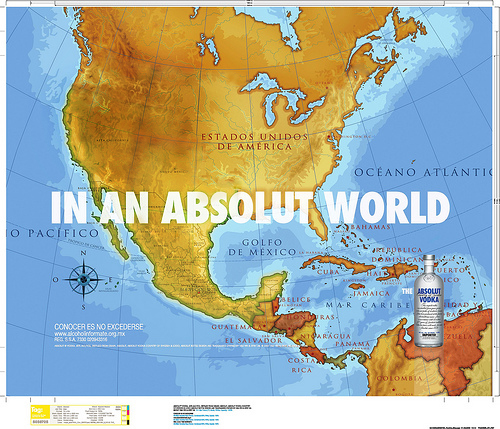
Given the drift of what had been tried and true, by 2008 when the campaigns have become "In an Absolut World" ads, the Mexican ad agency Teran.TBWA not only had a blank canvas, but an urging toward messaging as well. It is therefore understandable that an association with the products greatest consumers, just north of its border, became too ripe and opportunity to pass up.
The American West and Southwest, and it's annexation, are an unquestionable shared experience. What is questionable is for whom is this a point of pride, and for whom is this a point of shame or embarrassment. With so much leeway, can one really fault Teran.TBWA? The ad certainly push buttons, and do not good at sometimes do that? While this deeply into the inquiry one would hardly find fault with absolute itself, back in Sweden, many certainly did nonetheless. No one wants reminding of one neighbor usurping the other.
The Swedish distillery had paid well for the perception of quality communication in Mexico, by the choice of a top agency. Teran.TBWA was (and is) indigenous, yet every bit as capable as most that you would find on Madison Avenue. This choice was supposed to have spared them back translation, parallel translation and unforeseen cultural nuances. This went well beyond cultural nuance.
Perhaps an overreach to impress its new star client, Teran.TBWA went where it did. The unanswered question will remain whether they did what they did consciously or not. If it was the former, that is a significant calculated risk. One can only hope this was not reflective of a lack of research.
From the visual photo blog Flickr, we find two examples of reconfigured responses (seen here) (“Absolut“, 2008). Suffice to say, this ad only lives on in Internet postings.

Conclusion

Afterword (a responce to a colleague)
The phrase “In an Absolute World” seemed to be interpreted by the Mexican ad agency as "In an ideal world”. And, politically charged, to their perspective, in an ideal world Mexico would still have its original borders (and therefore be on par with the US, if only in land mass).
So much of the core of marketing can be subjective, but there are metrics. I have no idea if they used focus groups (or any other rubric) for how this would play, but for the substantial commission I assume they would have. Which brings me to: arresting or saying “it” badly. I do not recall my source, but the ad didn’t play long. I think they pulled it within a week. The point is I sense that the ad agency put this out there knowing it was a calculated risk, that they could (and might have to / did) dial it back.
That the fiscal year result yielded US -5%, Mexico +21 % (sales growth) seems a glowing success, and a tradeoff most corporations would be willing to go through with.
In my final point I will humbly submit that we are both correct. Unethical? Well, not empirically, no. But certainly at the edges. Wouldn’t you agree that it’s unethical to create an ad campaign with a pretty good idea (really, likely knowing) you’re gonna tick off an entire country? Why would anyone do that? To get a rise, to be controversial, to be edgy. You yourself cited “2257 posted comments many filled with hate and bigotry” … they caused a kerfuffle. And it made people look at their brand anew.
Ultimately, the most cogent piece underlying all this that remains presumptive is how calculating was the ad agency…and I would bet very. Absolut is a worldwide brand with deep pockets. This ad agency has handfuls of similarly situated rock star clients. They may have been willing to pull it back in a heartbeat, but it really is hard for me to imagine they let this out without testing.
Which means they knowingly upset people.
References
Absolut Vodka. (2010). Absolut Vodka. Retrieved November 19, 2010, from http://www.absolut.com/us
Absolut. (2008). Retrieved November 19, 2010, from http://www.flickr.com/photos/newcorrespondent/2383371667/
Absolute Ads website. (2010, ). [ comment]. Retrieved from http://www.absolutads.com/
This is a quick look at how a multinational company found its way into ticking off others through a marketing faux pas. We will be looking at what has now become something of an iconic error made by the makers of Absolut vodka.
Introduction
a bit of background
In the American colloquial vernacular the phrase, “let sleeping dogs lie” exists. It is imagined that many cultures have a similar phrase, indicating leaving the past in the past. The ad agency Teran.TBWA chose instead to leverage their past, and in some measure created a temporary detriment.

Soon, cachét began to be established. In the game of what can you relate to, we find that we relate to everything; consequently, the generic everywhere began to establish the amusement of how clever Absolut showed up (constantly dressed anew). There is an entire site dedicated to chronicling the hundreds of different Absolut ads just from these last few decades (and it is remarkable how obtuse and obscure some of them can be) (Absolute Ads website, 2010).
Naturally, marketing expertise would dictate to not stray too far afield. However, in the quest for constantly refreshing the content Absolut found itself drifting ever more abstractly. Slowly, this trajectory drifted from the high-minded “Absolut (fill in the superlative)” to self-deprecation, and merely “Absolut (fill in the blank)”.
Which is both where we find ourselves today, and where we meet our story, vodka is back to being relatively unremarkable (if no long cheap).
Viva Mexico
This document simply purports to be an acknowledgment, and pull from it some insight(s); in no way looking to diminish the larger success. Absolut remains “the most popular imported vodka in America. It's the third largest liquor brand worldwide…” (Beato , 2008).
So who would fault the Swedes for wanting to engage an agency on the ground in Mexico, to collapse any misunderstandings? Such an approach is classic marketing (Usunier & Lee, 2005).
Given the drift of what had been tried and true, by 2008 when the campaigns have become "In an Absolut World" ads, the Mexican ad agency Teran.TBWA not only had a blank canvas, but an urging toward messaging as well. It is therefore understandable that an association with the products greatest consumers, just north of its border, became too ripe and opportunity to pass up.
The American West and Southwest, and it's annexation, are an unquestionable shared experience. What is questionable is for whom is this a point of pride, and for whom is this a point of shame or embarrassment. With so much leeway, can one really fault Teran.TBWA? The ad certainly push buttons, and do not good at sometimes do that? While this deeply into the inquiry one would hardly find fault with absolute itself, back in Sweden, many certainly did nonetheless. No one wants reminding of one neighbor usurping the other.
The Swedish distillery had paid well for the perception of quality communication in Mexico, by the choice of a top agency. Teran.TBWA was (and is) indigenous, yet every bit as capable as most that you would find on Madison Avenue. This choice was supposed to have spared them back translation, parallel translation and unforeseen cultural nuances. This went well beyond cultural nuance.
Perhaps an overreach to impress its new star client, Teran.TBWA went where it did. The unanswered question will remain whether they did what they did consciously or not. If it was the former, that is a significant calculated risk. One can only hope this was not reflective of a lack of research.
From the visual photo blog Flickr, we find two examples of reconfigured responses (seen here) (“Absolut“, 2008). Suffice to say, this ad only lives on in Internet postings.

Conclusion
Teran.TBWA seems a highly competent agency. Its client list is impressive; including: Adidas, Apple, Dominos (pizza), Bayer, GlaxoSmithKline, Nextel, Nissan, Nivea, (pet foods) Pedigree and Whiskas, Starbucks and Visa (to name a few). Therefore, such a marketing powerhouse may well have known what it was doing. Although the question remains “did it really?” If it helps the reader's decision-making process whatsoever, rest assured they lived happily ever after; they still have the Absolut account.
Afterword (a responce to a colleague)
The phrase “In an Absolute World” seemed to be interpreted by the Mexican ad agency as "In an ideal world”. And, politically charged, to their perspective, in an ideal world Mexico would still have its original borders (and therefore be on par with the US, if only in land mass).
So much of the core of marketing can be subjective, but there are metrics. I have no idea if they used focus groups (or any other rubric) for how this would play, but for the substantial commission I assume they would have. Which brings me to: arresting or saying “it” badly. I do not recall my source, but the ad didn’t play long. I think they pulled it within a week. The point is I sense that the ad agency put this out there knowing it was a calculated risk, that they could (and might have to / did) dial it back.
That the fiscal year result yielded US -5%, Mexico +21 % (sales growth) seems a glowing success, and a tradeoff most corporations would be willing to go through with.
In my final point I will humbly submit that we are both correct. Unethical? Well, not empirically, no. But certainly at the edges. Wouldn’t you agree that it’s unethical to create an ad campaign with a pretty good idea (really, likely knowing) you’re gonna tick off an entire country? Why would anyone do that? To get a rise, to be controversial, to be edgy. You yourself cited “2257 posted comments many filled with hate and bigotry” … they caused a kerfuffle. And it made people look at their brand anew.
Ultimately, the most cogent piece underlying all this that remains presumptive is how calculating was the ad agency…and I would bet very. Absolut is a worldwide brand with deep pockets. This ad agency has handfuls of similarly situated rock star clients. They may have been willing to pull it back in a heartbeat, but it really is hard for me to imagine they let this out without testing.
Which means they knowingly upset people.
References
Absolut Vodka. (2010). Absolut Vodka. Retrieved November 19, 2010, from http://www.absolut.com/us
Absolut. (2008). Retrieved November 19, 2010, from http://www.flickr.com/photos/newcorrespondent/2383371667/
Absolute Ads website. (2010, ). [ comment]. Retrieved from http://www.absolutads.com/
Beato , G. (2008). Absolut Faux Pas. Reason Magazine. Advance online publication. Retrieved from http://reason.com/archives/2008/04/10/absolut-faux-pas
Staff (2008, April 3, 2008). Mexico reconquers California? Absolut drinks to that!. Los Angeles Times . Retrieved from http://latimesblogs.latimes.com/laplaza/2008/04/mexico-reconque.html
Teran\TBWA. (2010). http://www.terantbwa.com.mx/
Usunier, J., & Lee, J. A. (2005). Marketing Across Cultures (4th ed.). Essex, England: Pearson Education Limited.
Tuesday, November 23, 2010
Code of (Guiding Principals) Conduct; (Marketing)
Forward
Please emphasize the word guide in this code of conduct to guide sales and marketing employees in the various countries where our organization does business. This code leans heavily on normative guidelines as a superstructure against which modification of specific behaviors occurs on a case-by-case basis. For example, an assertive posture in North America may be perfectly appropriate, wherein the same behavior in the Far East will yield bruised relationships. A self-modifying behavioral shift is both wanted and needed in this circumstance. For purposes of contrast, hiring child labor in Indonesia is altogether unwarranted (although possible), wherein the hiring of child labor in Bangladesh (particularly if folded in with considerations of appropriate effort, breaks, meals, safety, educational opportunity and the like) may be a charitable contribution.
Fortunately, despite the extent to which such a document defies empirical expression, we are nonetheless dealing (ultimately) with the human condition; and we will always be more alike than different. Cycling back to normative guidelines, one will notice an effort toward the guiding principles and standards that mankind tends to share. While even these abstractions may be buffeted somewhat differently, culture-to-culture, doing the right thing is always the responsibility of anyone representing our company. If there is ever any question as to what to do, please contact the multicultural manager through human resources.
All that said, a few guiding principles: honesty, fairness, transparency, do no harm, do your homework, do your best and treat others the way you would want to be treated. If one must err, err on the side of caution. Default positions further include being conservative, deferring to precedent, seniors and elders. If something becomes questionable, question it (HR’s multicultural manager). The Zoroastrians have a guiding principle that we can also incorporate: good thoughts, good words, good deeds.
Code of (Guiding Principals) Conduct
Abstractions
Differing cultures have differing positions on matters of individual morals, ethical and moral reasoning, human rights and organizational ethical climate. It is the individual representative’s responsibility to be as fully prepared walking in, to have reasonable expectations and an internal locus established guiding sensibility. Principles such as trust, integrity, respect, honesty, responsibility and privacy may have somewhat altering appearances, yet they tend to be universal. Understanding that reasoning and relativism may be authentically different from culture to culture, where bright lines exist, the company would rather lose the business than compromise, given the convenient excuse to do so. For the gray areas in between, where such question exists, an internal review will occur internally on a case-by-case basis.
When such distinctions occur, and best practices established, documentation will occur in kind, and filed both with the local and home office (to be reviewed, and possibly updated, every five years). Relationships where working together (disagreements, and particularly agreements) between our organization and the country in question should inform and guide appropriateness.
the Established Subjective
Our marketing concern will never knowingly offend anyone. Indeed, we will go out of our way to ensure that never happens. Consistent with this ethic, we will never knowingly participate in any deception, by claim or advertising. We also make a distinction between healthy margins and predatory pricing; always seeking the former, however, never at the expense of the latter.
Matters of Justice
• We will never leverage the lesser than; lesser regulations, societies of lesser development, etc. We will always side with human rights (and wherever possible, will contribute charitably, as any good neighbor should).
• Everything we do is a promise of improvement. In some form, fashion, or another we will always seek to accentuate the positive, decrease the negative and otherwise leave a place / situation better than it was.
• Anything that may ever be construed as less than positive, a "mess", once brought to the attention of management, will be wholly owned and cleaned up; as our responsibility would dictate.
• We will shun institutions associated with the unsafe, working environments, products, etc.
• We will never leverage any political entity to unfair advantage. However, we will be friendly with our friends; seeking increased trade and an even playing field for all.
• We will seek to grow our business entity ever more environmentally friendly. To this end an annual report will be made available to the public.
• We do not participate in bribery. Where this dynamic occurs in other cultures, we will seek to emulate best practices so as to both honor that culture's perspective and maintain our own integrity.
Miscellaneous
Our marketing concern views these guiding principles as inherent to the fabric of our creativity. The overall spirit of who we are and of what we produce will naturally reflect our benchmark standards for excellence. This diplomatic high road will be one among our most distinguishing assets, and the calling underlying our branding.
References
American Marketing Association. (2005). the American Marketing Association’s (AMA) code of conduct . In the American Marketing Association’s (AMA) code of conduct . Retrieved from http://www.google.com/url?sa=t&source=web&cd=2&ved=0CBgQFjAB&url=http%3A%2F%2Fwww.marketingpower.com%2FCareers%2FDocuments%2FPCM%2520Application%2520Kit.pdf&ei=BMHnTOmZNsb_lgeM67i7Cw&usg=AFQjCNE3pngME_hdEkQOvKxtYa1GErAsUQ&sig2=nvERiaEYNIr1OxzKaGWEwg
Bourget , D., & Chalmers , D. (Eds.). (2010). philpapers. Retrieved from http://philpapers.org/rec/BOREIO
DJOglobal SALES & MARKETING CODE OF CONDUCT. (2009). In SALES & MARKETING CODE OF CONDUCT. Retrieved from http://www.google.com/url?sa=t&source=web&cd=5&sqi=2&ved=0CCkQFjAE&url=http%3A%2F%2Fwww.empi.com%2Fuploadedfiles%2Fabout_empi%2FMarketing%2520Code%2520of%2520Conduct.pdf&ei=q6PnTP7zGcT_lgeBotH1Cw&usg=AFQjCNGEi-JGnkx8Ie8gs-nWZ9rND9UJcw&sig2=9VLOTDvHY73H2R9Ugd-QtQ
Rallapalli, K. C. (1999). A Paradigm for Development and Promulgation of a GlobalCode of Marketing Ethics. Retrieved from Journal of Business Ethics: http://www.springerlink.com/content/w783265523872h20/fulltext.pdf
Usunier, J., & Lee, J. A. (2005). Marketing Across Cultures (4th ed.). Essex, England: Pearson Education Limited.
Word of Mouth Marketing Association . (2009). Ethics Code. In Ethics Code. Retrieved from http://womma.org/ethics/code/
World Health Organization. (1981). WHO International Code of Marketing of Breast-milk Substitutes. In International Code of Marketing of Breast-milk Substitutes. Retrieved from www.who.int/nutrition/publications/code_english.pdf
Please emphasize the word guide in this code of conduct to guide sales and marketing employees in the various countries where our organization does business. This code leans heavily on normative guidelines as a superstructure against which modification of specific behaviors occurs on a case-by-case basis. For example, an assertive posture in North America may be perfectly appropriate, wherein the same behavior in the Far East will yield bruised relationships. A self-modifying behavioral shift is both wanted and needed in this circumstance. For purposes of contrast, hiring child labor in Indonesia is altogether unwarranted (although possible), wherein the hiring of child labor in Bangladesh (particularly if folded in with considerations of appropriate effort, breaks, meals, safety, educational opportunity and the like) may be a charitable contribution.
Fortunately, despite the extent to which such a document defies empirical expression, we are nonetheless dealing (ultimately) with the human condition; and we will always be more alike than different. Cycling back to normative guidelines, one will notice an effort toward the guiding principles and standards that mankind tends to share. While even these abstractions may be buffeted somewhat differently, culture-to-culture, doing the right thing is always the responsibility of anyone representing our company. If there is ever any question as to what to do, please contact the multicultural manager through human resources.
All that said, a few guiding principles: honesty, fairness, transparency, do no harm, do your homework, do your best and treat others the way you would want to be treated. If one must err, err on the side of caution. Default positions further include being conservative, deferring to precedent, seniors and elders. If something becomes questionable, question it (HR’s multicultural manager). The Zoroastrians have a guiding principle that we can also incorporate: good thoughts, good words, good deeds.
Code of (Guiding Principals) Conduct
Abstractions
Differing cultures have differing positions on matters of individual morals, ethical and moral reasoning, human rights and organizational ethical climate. It is the individual representative’s responsibility to be as fully prepared walking in, to have reasonable expectations and an internal locus established guiding sensibility. Principles such as trust, integrity, respect, honesty, responsibility and privacy may have somewhat altering appearances, yet they tend to be universal. Understanding that reasoning and relativism may be authentically different from culture to culture, where bright lines exist, the company would rather lose the business than compromise, given the convenient excuse to do so. For the gray areas in between, where such question exists, an internal review will occur internally on a case-by-case basis.
When such distinctions occur, and best practices established, documentation will occur in kind, and filed both with the local and home office (to be reviewed, and possibly updated, every five years). Relationships where working together (disagreements, and particularly agreements) between our organization and the country in question should inform and guide appropriateness.
the Established Subjective
Our marketing concern will never knowingly offend anyone. Indeed, we will go out of our way to ensure that never happens. Consistent with this ethic, we will never knowingly participate in any deception, by claim or advertising. We also make a distinction between healthy margins and predatory pricing; always seeking the former, however, never at the expense of the latter.
Matters of Justice
• We will never leverage the lesser than; lesser regulations, societies of lesser development, etc. We will always side with human rights (and wherever possible, will contribute charitably, as any good neighbor should).
• Everything we do is a promise of improvement. In some form, fashion, or another we will always seek to accentuate the positive, decrease the negative and otherwise leave a place / situation better than it was.
• Anything that may ever be construed as less than positive, a "mess", once brought to the attention of management, will be wholly owned and cleaned up; as our responsibility would dictate.
• We will shun institutions associated with the unsafe, working environments, products, etc.
• We will never leverage any political entity to unfair advantage. However, we will be friendly with our friends; seeking increased trade and an even playing field for all.
• We will seek to grow our business entity ever more environmentally friendly. To this end an annual report will be made available to the public.
• We do not participate in bribery. Where this dynamic occurs in other cultures, we will seek to emulate best practices so as to both honor that culture's perspective and maintain our own integrity.
Miscellaneous
Our marketing concern views these guiding principles as inherent to the fabric of our creativity. The overall spirit of who we are and of what we produce will naturally reflect our benchmark standards for excellence. This diplomatic high road will be one among our most distinguishing assets, and the calling underlying our branding.
References
American Marketing Association. (2005). the American Marketing Association’s (AMA) code of conduct . In the American Marketing Association’s (AMA) code of conduct . Retrieved from http://www.google.com/url?sa=t&source=web&cd=2&ved=0CBgQFjAB&url=http%3A%2F%2Fwww.marketingpower.com%2FCareers%2FDocuments%2FPCM%2520Application%2520Kit.pdf&ei=BMHnTOmZNsb_lgeM67i7Cw&usg=AFQjCNE3pngME_hdEkQOvKxtYa1GErAsUQ&sig2=nvERiaEYNIr1OxzKaGWEwg
Bourget , D., & Chalmers , D. (Eds.). (2010). philpapers. Retrieved from http://philpapers.org/rec/BOREIO
DJOglobal SALES & MARKETING CODE OF CONDUCT. (2009). In SALES & MARKETING CODE OF CONDUCT. Retrieved from http://www.google.com/url?sa=t&source=web&cd=5&sqi=2&ved=0CCkQFjAE&url=http%3A%2F%2Fwww.empi.com%2Fuploadedfiles%2Fabout_empi%2FMarketing%2520Code%2520of%2520Conduct.pdf&ei=q6PnTP7zGcT_lgeBotH1Cw&usg=AFQjCNGEi-JGnkx8Ie8gs-nWZ9rND9UJcw&sig2=9VLOTDvHY73H2R9Ugd-QtQ
Rallapalli, K. C. (1999). A Paradigm for Development and Promulgation of a GlobalCode of Marketing Ethics. Retrieved from Journal of Business Ethics: http://www.springerlink.com/content/w783265523872h20/fulltext.pdf
Usunier, J., & Lee, J. A. (2005). Marketing Across Cultures (4th ed.). Essex, England: Pearson Education Limited.
Word of Mouth Marketing Association . (2009). Ethics Code. In Ethics Code. Retrieved from http://womma.org/ethics/code/
World Health Organization. (1981). WHO International Code of Marketing of Breast-milk Substitutes. In International Code of Marketing of Breast-milk Substitutes. Retrieved from www.who.int/nutrition/publications/code_english.pdf
Monday, November 22, 2010
Marketing in Indonesia [a textbook / thoughts on]
Abstract
This document seeks to explore the marketing possibilities of bringing a presumed product (a yet incomplete, let alone translated textbook) into an other country, Indonesia. A cursory analysis of the marketing industry as it exists on the ground will be taken up; and two agencies will be chosen (and further, consider their merits).
Essentially a strategy document, having established something of a baseline there will then be a consideration formed seeking to maximize what there is to work with.
Welcome to Paradise
Wherefore Indonesian Marketing
This author has written elsewhere that Indonesia is not exactly an icon of business efficiency in the Western sense of things. The first item confronted was that there was no ready reference for the marketing industry in that country in English. The PPPI (or Indonesian Advertising Agency Association) website does not readily yield the needed information (PPPI (the Indonesian Advertising Agency Assoc.), n.d.).
Therefore, the first order of business was to create from scratch a database of potential organizations with which to work. Unfortunately, this took an inordinate amount of time. As it stands, after three days effort, it is only about one third complete. Nonetheless, this gives us something with which to work, predicating this paper is on just those 50.
The database yields an explosion of patterns worthy of acknowledgment. Among the first that draws our attention is that an unusual number of ad agencies base in Surabaya. There is no ready explanation; Surabaya is the second largest city in the country, representing a counterweight on Java Island on the easternmost to Jakarta (the largest city and the capital) on the western end. The next pattern we find is the severe disparity between the extremely few elite agencies (the bulk of which have been inserted from the US) and the majority of the domestically grown variety, the vast majority of which do not even have a web presence of their own. This latter acknowledgment is disappointing to say the least, for it carries with it implications that the country has a severely underdeveloped domestic expression.
Chosen/Not Chosen

Not to overdo, and the reader is reminded one more time that this is an exercise based on fact. BBDO Indonesia and Leo Burnett Kreasindo get tossed out immediately as overkill (Ogilvy and other Madison Avenue icons are also present in Indonesia). These two institutions represent two considerations: the first is that you get what you pay for and these people are the best. The other consideration is that they are not wholly indigenous; their core DNA is with the US.
All this finds us with approximately a half a dozen choices left. There really is that small an amount of web presence. Removing the websites that either do not work or are under construction, or about building websites alone, we are left with three: Cody Enterprises (http://www.codyenterprises.com/; which is too obtuse to embrace), Bensatra Advertising (http://www.bensatra.com/ads.php; which seems wholly outdoor advertising) and Blue Circle Advertising (http://www.bluecircle-adv.com/). Blue Circle, by the way, seems every bit as impressive as BBDO and Leo Burnett and it is indigenous (it is nice to know the possible has precedent, however small).
If it were left up to this deductive reasoning, we have already whittled past the two mark to one. While it is an easy enough supposition to back up and embrace Bensatra, let us pause a moment.
The Strategy
One recalls that the author already has created a database of art schools (to which our presumed textbook gets marketed directly). This approach has local marketing built into it, replete with distribution channel and direct marketing.
One begins to wonder why we would bother with any ad agencies at all. As part of the larger marketing exercise, this author is grateful for the opportunity to effort in that direction. However, the fact remains that there is very little that needs completion by the power and wisdom of big dollars (the best artist’s money can rent) and decades of trial and error based intuition.
A simple RFP may be offered to all the art schools (that have advertising related applied arts within their offerings) to create a small suite of printed material. This would likely include a poster (for use in a bookstore, school cafeteria, etc.), bookmarks and postcards.
Conclusion
When the textbook finds its finished publication, and that it may ever see translation into Indonesian, the just aforementioned strategy approach certainly seems ample. There is no need for a massive ad campaign, television, radio, billboards, etc.
Nonetheless, the effort to develop a database of ad agencies in Indonesia has already revealed enormous opportunities for said applied artists. The shortcomings discovered will have to be included in the book itself, and certainly adds to the essential marketing knowledge base of this author.
Unable to fold the database in question into an appendix here, the kind reader is invited to look for it as a separate attachment.
References
Haymarket Media Limited. (2010). VenueDirectory [search engine, country specific]. : http://www.venue-directory.asia/.
Infomedia Nusantara a member of TELKOM Group. (2010). Yellow Pages Indonesia [search engine, country specific]. : http://www.yellowpages.co.id/en.
Netcode, Inc. . (2010). ZipLeaf [search engine, country specific]. : http://id.zipleaf.com/.
PPPI (the Indonesian Advertising Agency Assoc.). (n.d.). (home page). Retrieved November 17, 2010, from http://www.pppi.or.id/
Urbanesia.com. (2010). urbanesia [search engine, country specific]. : http://www.urbanesia.com/.
bensatra advertising. (n.d.). (home page). Retrieved November 17, 2010, from http://www.bensatra.com/ads.php
bluecircle advertising. (n.d.). (home page). Retrieved November 17, 2010, from http://www.bluecircle-adv.com/
indobizdb. (2010). indobizdb [search engine, country specific]. : http://indobizdb.com/.
Friday, November 5, 2010
Marketing an Applied Visual Arts textbook in Indonesia
Abstract
The author is in negotiations to produce a business primer textbook specific to the applied arts (an outline appears in the Appendix). Given the evolution and inextricability of Globalization, the text intends to speak to global (as opposed to domestic) concerns, as a matter of course.
The easy target would be to market the textbook to all the art institutions in the US. However, a true test of the text would lie in its ready ability to be translated and adopted elsewhere.
Although the author is not part of the marketing arm of the publisher (nor presuming to tell them what to do), this document serves purely as an exercise of the text itself to explore some considerations exactly to that end, in Indonesia.
A combined back translation along with a blind parallel translation of the text would be ideal. Given that the Indonesian currency, the rupiah, has been trading in the 40s to the US dollar for more than a decade now, the cost of such extensive translation is easily justified. It is useful to note that the presumed publisher, AVA, is Swiss-based, with an English-language subsidiary in the UK, chiefly for translation purposes. It would be a small matter to engage a few other-language translators on a consulting basis.
Indonesia
Context & Consideration
If one were to market this textbook into Indonesia, the first natural audience would also be institutions of higher learning. A cursory look at the market yields more than 30 such institutions on the island of Java alone (a table appears in the Appendix). For the unacquainted, that should be read as staggering; there is no equivalent in the US. For balance, consider the entirety of the archipelago as likened metaphorically to a region in the US as one would have to concede, the island of Java is the downtown of the big city of that region. Nonetheless, these numbers bode well. This author's numbers place all institutions of higher learning for art in the US at a number just over 150. Conservatively, if one were to pad that number by 25% that still clocks in fewer than 200. Without being exhaustive of the other 17,000+ islands, one imagines that further research would reveal at least as many more institutions (and the thought remains that this is severely understated).
Among the cautions as regards the numbers of institutions is that approximately half of the 30 are not just applied arts schools, but specifically schools associated with fashion. Given approximately a dozen other arenas of applied arts, it remains currently possible that there would be handfuls of schools focusing in similar other direction, photography, animation, etc., not yet unearthed.
There may also be institutions just hanging on with a student or two. While this may be the case anywhere in the world, let us look at one of the institutions that indicates itself as a standard among the rest; the Indonesia Institute of the Arts (the ISI) in Yogyakarta. According to their site, they average a student population of 2500, one hundredths of which are foreign, with semester tuition cost of approximately $1000 US.
Given the cursory nature of the research (not definitive, yet a solid start) one can be cautiously confident that the market in Indonesia for such a textbook definitely exists. If only 1/10 of the students at the ISI purchased the textbook, that is 250 units. The next suggested step in this process would be to become more definitive about the database; if for no other reason but to support the on-ground marketing representative in saturating the market.
Phase 2
An easy conjecture is that if market research dollars were spent, we would find a healthier alternative market than one might in a Western country. This is predicated on a number of things: Indonesian literacy has been increasingly on the rise, technology remains limited relative to Western countries based on the current price tag and Indonesians are increasingly hungry to participate in the global economy (and the product is a business primer).
The preceding paragraph serves to introduce the second consideration for penetrating the Indonesian market. A marketing representative (of the right qualifications, demonstrated sales ability and a familiarity with the book trade), armed with all the research necessary would be able to penetrate at least the secondary education market, and possibly a significant amount of the book vendors as well. Please also note that the actual production for AVA occurs just across the Malacca Straits in Singapore. This already in place association might further inform the larger movement.
The marketing representative would almost have to be an Indonesian. "...To set up in Indonesia there are plenty of day-to-day challenges to keep you on your toes..." (New Zealand, Trade & Enterprise (Government of) , 2010). While no one wants to hear such cautionaries, it is smart at a minimum to be aware of the many layered, multicultural considerations that would otherwise burden on noncitizen with a nagging, constant mandate to translate everything. Again, given the thoughtful approach and the right research, the cost may easily be justified.
With Indonesia, as a significant aspect of the ASEAN (Associations of the organization of Southeast Asian Nations), and a significant Democratic presence in the region, such an opportunity becomes a great test market for entrée into the larger Asian market.
All the Rest
The reader may be inclined to view this document as something of a compromise vis-à-vis the larger conversation of marketing into a new country. The author recognizes that the implication of demographic has little effect, insofar as the overarching conversation for an Indonesian artisan student and an American artisan student is the global business nature of the art (which flattens the conversation, culturally). Indeed, the global approach to the business text consciously collapses the collateral material as well: posters for bookstores, bookmarks and the like. Beyond excellent translation, there should be no overt difference.
Among the challenges was to increase sales by 50%. However, taking this product into the Indonesian market increases sales by 100% (for a market that had not yet existed). Given the product does not exist yet, and would presumably be offered to an American audience first, comparatively speaking, there is no current way to have Indonesian sales constitute half of American sales. This is simply recognition of the generic comparative of supply-chain, as it exists in the US with almost anywhere else in the world.
The exercise that this document constitutes recognized such disparities going in. The embrace of Indonesia was pursued given the ability to justify other goals: a more Asian entrée to the Asian market (otherwise India is also attractive), the proximity to the subsidiary operations in Singapore, the democracy of the country and the attractive economic considerations (Australian School of Business UNSW , 2010) (Sauvin , 2010).
Conclusion(s)
The author is familiar enough, with both Indonesia, and marketing in general, to recognize that one could paint the larger conversation with the following broad-brush stroke: the cosmopolitan Indonesian that would be the market for such an item is, at essence, no different from his or her Western counterpart. What is different, however, while minor, needs noting nonetheless (the covert). These would be the subtle nuances of communication, negotiation, and day-to-day interaction generally. With a significant Chinese minority deeply embedded in the business class, with the largest Muslim population on the planet and Indians among the significant minorities, one finds a whole host of details that we simply need to honor. This would include paying attention to one's basic posture (not literally but figuratively) in human interaction. Also, the colors being used in communication, the kinds of visual matter that one needs to avoid and even the business card of the marketing representative (Anonymous, 2008)(“Executive Planet“, 2010)(Global Marketing Strategies, 1997-2010)(Hofstede, 2009)(House, R., Hanges, P.J., Javidan, M., Dorfman, P.W., & Gupta, V. , 2004)(Kwintessential Ltd, 2010)(World Business Culture, n.d.).
Approval for the textbook remains pending. Is this a presumption of a fantasy or an academic exercise; humbly submitted this offering is the latter. Nonetheless, if AVA were so inclined, Indonesia represents a cost-effective market and a potentially excellent entrée into Asia.
References
AVA Academia. (2010). http://www.avabooks.ch/
Anonymous (2008). Negotiating International Business - Italy. Global Negotiation Resources. Retrieved from http://www.globalnegotiationresources.com/
Arts Business Institute, (2009, Friday, April 3, 2009). Economic Importance of Art [Web log message]. Retrieved from http://artsbusinessinstitute.blogspot.com/
Australian School of Business UNSW . (2010, June 4, 2010). Marketing in Indonesia - challenges and opportunities ([under: News & Events]). Retrieved from Australian School of Business UNSW : http://www.asb.unsw.edu.au/newsevents/mediaroom/media/2010/april/Pages/marketingindonesia.aspx
Edwards, B. (1979). Drawing on the Right Side of the Brain (1st ed.). Los Angeles, CA: Jeremy Tarcher.
Executive Planet. (2010). Retrieved from http://www.executiveplanet.com/index.php?title=Main_Page
Friedman, T. (2005). The World Is Flat. New York: Farrar, Straus & Giroux .
Global Marketing Strategies. (1997-2010). Global Negotiator [[muscular collection to internal pages with developed information] http://www.globalnegotiator.com/]. Retrieved from : Global Marketing Strategies.
Hernández Requejo, W., & Graham, J. L. (2008 - 2010). . In Global Negotiation: The New Rules (p. ). Retrieved from http://www.globalnegotiationbook.com/
Hill, C. W. (2008). . In (Ed.), Global Business Today (5th ed, pp. 519-522). NY: McGraw Hill/Irwin.
Hofstede, G. (2009). Geert Hofstede™ Cultural Dimensions. Retrieved from http://www.geert-hofstede.com/
House, R., Hanges, P.J., Javidan, M., Dorfman, P.W., & Gupta, V. . (2004). Culture, Leadership, and Organizations-The GLOBE Study of 62 Societies. In Culture, Leadership, and Organizations-The GLOBE Study of 62 Societies. Thousand Oaks, CA 91320: Sage Publications.
Inglehart , R. (2009). [charts] [World Values Surveys]. Retrieved from http://www.worldvaluessurvey.org/wvs/articles/folder_published/article_base_54
International Labor Organization. (2008). Global Wage Report 2008/09 Towards policy coherence: Minimum wages and collective bargaining [9789221214991 (ISBN)]. Retrieved from http://www.ilo.org/global/What_we_do/Publications/ILOBookstore/Orderonline/Books/lang--en/docName--WCMS_097013/index.htm
Kim, W. C., & Mauborgne, R. (2005). Blue Ocean Strategy: How to create uncontested market spece and make the competition irrelevant. Boston, MA: Harvard Business School Publishing.
Kwintessential Ltd. (2010). Language, Culture, Customs and Etiquette - Japan - Language, Culture, Customs and Etiquette - Sweden. Retrieved September 25, 2010, from http://www.kwintessential.co.uk/resources/global-etiquette/
Nazief, B., Ph.D. ((between 1999 + 2010)). Development of Computational Linguistics Research: a Challenge for Indonesia (Doctoral dissertation, University of Indonesia, Jakarta). Retrieved from http://www.google.com/url?sa=t&source=web&cd=1&sqi=2&ved=0CBMQFjAA&url=http%3A%2F%2Fwww.ldc.upenn.edu%2Facl%2FP%2FP00%2FP00-1075.pdf&rct=j&q=research%20challenge%20indonesia&ei=X6vRTJr4Csys8Ab72KTHDA&usg=AFQjCNGnS-LjzjBu7FhuvGgozB1hGHJ-2A&sig2=xP8728Cakuj10TM2Opss3g
New Zealand, Trade & Enterprise (Government of) . (2010). Doing business in Indonesia. Retrieved from New Zealand Trade and Enterprise: http://www.nzte.govt.nz/explore-export-markets/south-and-southeast-asia/doing-business-in-indonesia/Pages/Doing-business-in-Indonesia.aspx
Peng, M. W. (2009). . In Global Business ( pp. 442-444). Mason, OH: Southwestern Cengage Learning.
Sauvin , S. (2010, October 1, 2010). Print advertising up 20% in Indonesia. snfblog.com. Retrieved from http://www.sfnblog.com/advertising/2010/10/indonesian_newspapers_continue_reliance.php
Singapore Economic Development Board. (2009). . Retrieved from http://www.edb.gov.sg/edb/sg/en_uk/index.html
World Business Culture. (n.d.). American Management Style, South Korean Management Style and Japanese Management Style (respectively). Retrieved Sept. 18, 2010, from http://www.worldbusinessculture.com/South-Korea-Management-Style.html; http://www.worldbusinessculture.com/Japanese-Management-Style.html; http://www.worldbusinessculture.com/American-Management-Style.html
Tuesday, November 2, 2010
Marketing IKEA Indonesia
Abstract
This is a critique of the Marketing strategy for IKEA in Indonesia. Fortunately, said plan was recently published, and therefore is readily available for a direct assessment.
IKEA in Indonesia
Brief background
Ingvar Kamprad Elmtaryd Agunnaryd (IKEA) is so named after the founder (Ingvar Kamprad), the farm he grew up on (Elmtaryd) and the Parrish it was located in (Agunnaryd). The organization is widely established globally, however, until recently it had targeted developed nations. IKEA is a privately held in trust.
Critique of the Plan
Core Marketing/Business
Early on, the marketing plan (Please view the actual Marketing Plan. The URL is in the reference section) cites a particular strength for the IKEA furnishings line, their relatively low price. However, the deeper we go into the marketing plan, the more we realize that they are aware that their prices may not be low enough to reach the lowest classes. Key elements that are missed include that IKEA's value also lies in its generic, spare style, its conscious use of space in particular and the ability to build it yourself. Chiefly due to this marketing plan being constructed almost entirely on secondary data, the secondary data errors pepper the entire marketing plan.
The document acknowledges the current Indonesian growth rate, yet does not celebrate it. Note that 6.1% growth is rather healthy today.
The marketing plan is correct to delve into a consideration of infrastructure. However, the infrastructure that IKEA is lamenting is the familiar (European style) infrastructure. The truth of the matter is, for this country and this culture, the infrastructure is relatively muscular. Inadequate compared to most developing countries, but Indonesia must have somewhere in the neighborhood of 50 times the waterways, most urban areas (where they plan to settle) have at least base roads.
The marketing plan is equally correct in acknowledging the legal and ethical considerations on the ground. Again, everything is relative and overlooked again is this relativism. Corruption and IP law may be concerns, and should not be worries, for this is no more than most of Asia.
Then the marketing plan moves in the direction of quickly over viewing the demographic, and does so very sweepingly using the operative word diverse. From rainforest tribes to cosmopolitans, there is no question of such diversity among the people. However, in targeting only urban settings (and even the contemplation of suburban settings), this conversation would be more appropriate if one were looking to market a government agency, not a big box retail opportunity. IKEA's demographic is consistent with where they are locating.
Again, IKEA would do well to get on the ground first. This challenge of perspective persists even when contextualizing itself with competition. It is noteworthy that the majority of furnishing retailers still resides with smaller players. Much like the GDP mentioned earlier, this mention is so fleeting that one wonders if the new president and CEO Mikael Ohlsson can appreciate the full gravity of the opportunity. To underscore, this supposition of a plan continues to lean on what it does know, comparing itself to Carrefour, among others. These major otherwise focused box stores (Carrefour is analogous to WalMart in Europe) sometimes focus on groceries, etc. Despite their specialty, IKEA could go toe to toe if they so chose. Often IKEA has a food court and/or dining space. Is that the trend, to enter the Carrefour/WalMart arena? The recommendation would caution against such thoughts, at least in the initial entry phase to Indonesia.
The People
As we begin to speak of the Indonesians themselves, IKEA has fed itself some misinformation. Because Indonesians support artisans, the conclusion is that the population would not embrace do-it-yourself projects. Indonesians would embrace DIY activities, for the sake of it, as they love to express accomplishment (a very proud people). DIY is simply a concept that no one has consciously promoted yet! What a lost opportunity!
The ability to laser cut intricate lacework patterns could emulate a vast array of native furniture carving. The wealth of native fabric patterns (batik and the like) become another easy add (and an opportunity for strategic alliances on the ground).
The statement was made: “Showrooms should be designed and arranged in Indonesian style…”. It is unclear what this means. The floor plan for IKEA in Tampa would be perfect for Indonesians (who, as already indicated elsewhere in the marketing plan, and rightly so, see shopping as a weekend family entertainment).
Country specific
Toward the end of the document, the idea is floated of a secondary presence on Java. Expanding on Java would be cautioned against until after enough other major cities have been established. There is a saturation factor that is overlooked ... people on the furthest end of Java will use the Jakarta location just fine, and indefinitely. This expansion notion comes excessively soon.
Completely ignored is Sumatra Island, the fourth largest Island in the world. The capital city, Medan, in the north, is a substantial city directly affecting the top half of the island. Medan is the closest significant city to the city-state of Singapore, strategically less than an hour away by puddle jumper, just across the Malacca Straits. More strategic rationale would include Medan's proximity to Padang and Kuala Lumpur, Malaysia. The stain of secondary data persists. To cite cities such as Surabaya and Bandung, and then complain about infrastructure, would be disingenuous were it not for the innocent lack of research that is so evident.
Sumatra or not, establish small store presence in every major city first, and let the cities development of sales dictate where to expand next.
Miscellany
Do the local’s one better and accentuate IKEA's green stance - shout it out that the corporation seeks to support - not rape - the rainforest hardwoods.
Conclusion
Numerous pros and cons find themselves missed in IKEA’s marketing plan. With an eye toward a relatively collectivistic culture, aspects of IKEA’s spare look can communicate, and Indonesians would easily celebrate IKEA’s mastery of use of space.
In the metropolitan areas, the demographic is more consistent with what IKEA is accustomed to than they realize. Upper middle class and above will continue to favor the deeply carved exotic hardwoods that are the heirloom staple. The cost differential is more than made up for in the quality and longevity (and the magnificent artistry) of the native item. IKEA’s presumption disfavors the Indonesians buying acumen, and they will find their market will actually reach into the middle lower class.
There is no doubt the research being secondary has denied IKEA the wisdom being on the ground would have given them. Someone needs to forward them this document! The assessment is that much of the plan is solid, though could be rated at 75%.
References
Hartung, A. (2010, Nov. 1 2010). Growth - Dealing with Market ShiftsCould Something Go - Badly for Ikea and Its New CEO?. Forbes. Retrieved from http://blogs.forbes.com/adamhartung/2010/11/01/could-something-go-badly-for-ikea-and-its-new-ceo/?boxes=Homepagechannels
Ingvar Kamprad Elmtaryd Agunnaryd . (2009). Strategic Marketing Plan 2009, IKEA Expansion toIndonesia ((pdf) Marketing Plan). Retrieved from (publicly published internal information): http://www.google.com/url?sa=t&source=web&cd=3&sqi=2&ved=0CCQQFjAC&url=http%3A%2F%2Fherdianti.com%2FIKEA_in_Indonesia_files%2FHerdiantiW-IKEAExpansiontoIndonesia-StrategicMarketingPlan.pdf&rct=j&q=IKEA%20Indonesia&ei=8tnKTIXoMML68AbMutTtAQ&usg=AFQjCNES4FE00IJbyD5z4v79le_uf68QiQ&sig2=ssmgjPlP9LX5f5fbjFAcIg
Subscribe to:
Posts (Atom)