Showing posts with label packaging design. Show all posts

Wednesday, November 24, 2010

International Marketing Ethics

Abstract

This is a quick look at how a multinational company found its way into ticking off others through a marketing faux pas. We will be looking at what has now become something of an iconic error made by the makers of Absolut vodka.


Introduction

a bit of background

In the American colloquial vernacular the phrase, “let sleeping dogs lie” exists. It is imagined that many cultures have a similar phrase, indicating leaving the past in the past. The ad agency Teran.TBWA chose instead to leverage their past, and in some measure created a temporary detriment.
To appreciate fully how we come to this point we have to start in the early 1980s. There we find a Swedish distillery looking to reach beyond its borders. Back then, all vodka seemed as relatively cheap and unremarkable. “…a cheap commodity that was so generic even Communists couldn't screw it up too badly.” (Beato , 2008). Absolut started by choosing a silhouetted bottle that was simultaneously remarkable and unremarkable, a relatively generic shape, yet also associated with medicine bottles. Its ad campaign was similarly shrewd, a template base within which featured a short phrase, beginning with the word that is the name of the product.

Soon, cachét began to be established. In the game of what can you relate to, we find that we relate to everything; consequently, the generic everywhere began to establish the amusement of how clever Absolut showed up (constantly dressed anew). There is an entire site dedicated to chronicling the hundreds of different Absolut ads just from these last few decades (and it is remarkable how obtuse and obscure some of them can be) (Absolute Ads website, 2010).

Naturally, marketing expertise would dictate to not stray too far afield. However, in the quest for constantly refreshing the content Absolut found itself drifting ever more abstractly. Slowly, this trajectory drifted from the high-minded “Absolut (fill in the superlative)” to self-deprecation, and merely “Absolut (fill in the blank)”.

Which is both where we find ourselves today, and where we meet our story, vodka is back to being relatively unremarkable (if no long cheap).


Viva Mexico

This document simply purports to be an acknowledgment, and pull from it some insight(s); in no way looking to diminish the larger success. Absolut remains “the most popular imported vodka in America. It's the third largest liquor brand worldwide…” (Beato , 2008).

So who would fault the Swedes for wanting to engage an agency on the ground in Mexico, to collapse any misunderstandings? Such an approach is classic marketing (Usunier & Lee, 2005).

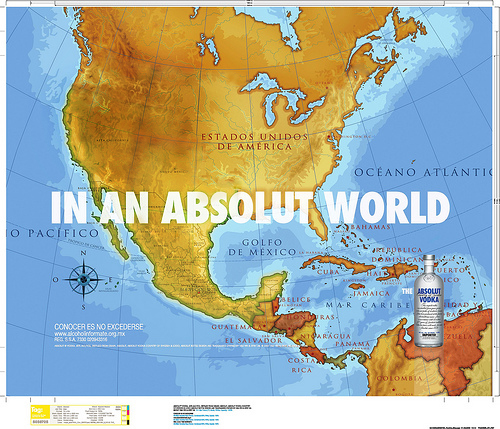
Given the drift of what had been tried and true, by 2008 when the campaigns have become "In an Absolut World" ads, the Mexican ad agency Teran.TBWA not only had a blank canvas, but an urging toward messaging as well. It is therefore understandable that an association with the products greatest consumers, just north of its border, became too ripe and opportunity to pass up.

The American West and Southwest, and it's annexation, are an unquestionable shared experience. What is questionable is for whom is this a point of pride, and for whom is this a point of shame or embarrassment. With so much leeway, can one really fault Teran.TBWA? The ad certainly push buttons, and do not good at sometimes do that? While this deeply into the inquiry one would hardly find fault with absolute itself, back in Sweden, many certainly did nonetheless. No one wants reminding of one neighbor usurping the other.

The Swedish distillery had paid well for the perception of quality communication in Mexico, by the choice of a top agency. Teran.TBWA was (and is) indigenous, yet every bit as capable as most that you would find on Madison Avenue. This choice was supposed to have spared them back translation, parallel translation and unforeseen cultural nuances. This went well beyond cultural nuance.

Perhaps an overreach to impress its new star client, Teran.TBWA went where it did. The unanswered question will remain whether they did what they did consciously or not. If it was the former, that is a significant calculated risk. One can only hope this was not reflective of a lack of research.

From the visual photo blog Flickr, we find two examples of reconfigured responses (seen here) (“Absolut“, 2008). Suffice to say, this ad only lives on in Internet postings.


Conclusion

Teran.TBWA seems a highly competent agency. Its client list is impressive; including: Adidas, Apple, Dominos (pizza), Bayer, GlaxoSmithKline, Nextel, Nissan, Nivea, (pet foods) Pedigree and Whiskas, Starbucks and Visa (to name a few). Therefore, such a marketing powerhouse may well have known what it was doing. Although the question remains “did it really?” If it helps the reader's decision-making process whatsoever, rest assured they lived happily ever after; they still have the Absolut account.


Afterword (a responce to a colleague)


The phrase “In an Absolute World” seemed to be interpreted by the Mexican ad agency as "In an ideal world”. And, politically charged, to their perspective, in an ideal world Mexico would still have its original borders (and therefore be on par with the US, if only in land mass).

So much of the core of marketing can be subjective, but there are metrics. I have no idea if they used focus groups (or any other rubric) for how this would play, but for the substantial commission I assume they would have. Which brings me to: arresting or saying “it” badly. I do not recall my source, but the ad didn’t play long. I think they pulled it within a week. The point is I sense that the ad agency put this out there knowing it was a calculated risk, that they could (and might have to / did) dial it back.

That the fiscal year result yielded US -5%, Mexico +21 % (sales growth) seems a glowing success, and a tradeoff most corporations would be willing to go through with.

In my final point I will humbly submit that we are both correct. Unethical? Well, not empirically, no. But certainly at the edges. Wouldn’t you agree that it’s unethical to create an ad campaign with a pretty good idea (really, likely knowing) you’re gonna tick off an entire country? Why would anyone do that? To get a rise, to be controversial, to be edgy. You yourself cited “2257 posted comments many filled with hate and bigotry” … they caused a kerfuffle. And it made people look at their brand anew.

Ultimately, the most cogent piece underlying all this that remains presumptive is how calculating was the ad agency…and I would bet very. Absolut is a worldwide brand with deep pockets. This ad agency has handfuls of similarly situated rock star clients. They may have been willing to pull it back in a heartbeat, but it really is hard for me to imagine they let this out without testing.

Which means they knowingly upset people.


References

Absolut Vodka. (2010). Absolut Vodka. Retrieved November 19, 2010, from http://www.absolut.com/us

Absolut. (2008). Retrieved November 19, 2010, from http://www.flickr.com/photos/newcorrespondent/2383371667/

Absolute Ads website. (2010, ). [ comment]. Retrieved from http://www.absolutads.com/

Beato , G. (2008). Absolut Faux Pas. Reason Magazine. Advance online publication. Retrieved from http://reason.com/archives/2008/04/10/absolut-faux-pas

Staff (2008, April 3, 2008). Mexico reconquers California? Absolut drinks to that!. Los Angeles Times . Retrieved from http://latimesblogs.latimes.com/laplaza/2008/04/mexico-reconque.html

Teran\TBWA. (2010). http://www.terantbwa.com.mx/

Usunier, J., & Lee, J. A. (2005). Marketing Across Cultures (4th ed.). Essex, England: Pearson Education Limited.

Sunday, November 7, 2010

Sustainability [01]

   From the business perspective, the idea of sustainability tends to be weighed in a cost-benefit analysis. It may seem the idea leaves a taste of immorality and may feel somewhat insulting. We will get back to that in a moment.
   From a design perspective, sustainability represents just one more challenge among the several that constitute working with what you have. Fortunately, much of this conversation should unfold in the process of your learning your particular artistic direction. There is certainly plenty that has been and it is being published to this end, and to more fully moved in the direction of mastery you really owe it to yourself to appreciate the fullness of this new aspect. This section will close out with a cursory view of some of the more significant sustainability considerations, major by major.
   Back to business. There has been a fortunate increase in sensitivity toward social responsibility. It nonetheless remains true there are still plenty of multinational corporations that will move operations where they can continue to pollute. It is also true that sometimes a cost of operations is seen as outweighing an extra expenditure that would find the product safer (for the environment and or the consumer). Bear in mind, corporations (especially those publicly traded) have an obligation to increase shareholder wealth. Even capitalism has its flaws.
   So we understand the downside. The best way to address it seems to be to focus on the upside. It has already been acknowledged here that there is increasing consumer awareness toward being green. All by itself this has yielded huge dividends to companies that have paid heed. Going green no longer has to always translate into paying a premium either. Being socially responsible also yields huge marketing dividends.
   Then, of course, they're the companies that are laying the foundation for other companies to go green. Konica Minolta has been working on a new line of fabric dyes of extraordinary brilliance that are also environmentally (and human) friendly. This is no small thing. In the bad old days there were many dyes that were outright toxic. In struggling economies where dyeing cloth was done manually (and, of course, some of this still lingers) people simply worked as long and as hard as they could, and eventually died from contact with such chemicals. Without lingering too long on the fashion industry, just think of all the chemicals that go into leather (that, eventually, leech transdermally into the wearer).
   Where companies can go green they do. It's moving beyond this low hanging fruit that the global community is now wrestling through. Ultimately, some more gains we make, the lower the cost, the easier it is to do and the better off we are. We are moving in the right direction.

Advertising: Illustration Graphics & Production
   Our little example a moment ago with the clothing dyes certainly had analogy in this area. Actual cobalt is a real toxin, yet used to be powdered and mixed with the medium, exposing artists by breathing it in or exposure to the skin. Beyond significant examples such as this, there have always been issues with ventilation surrounding all the solvents.
   Tremendous gains have been made on this front over the last half-century. However, we have now moved from an entirely organic paradigm (as faulted as aspects of it may have been) to now using a significant amount of synthetics.
   That was a brief consideration from the design perspective. From the business perspective this is the aspect of the industry that does a tremendous amount of printing, and where packaging designed lives.
   As regards printing, we have plenty of recycled paper product, and there are also “green” inks. There are even eco-friendly fonts! The issue here, of course, is how much of this can be translated into something the client will want (and be consistent with what they need).
   When it comes to packaging design, the iconic mistake would be bottled water. Possibly dangerous from all the chemicals in the plastic leaching into the water. Beyond that, the packaging costs significantly more than its contents, and maybe around in landfills for generations so that someone would have refreshment across a brief period of time. And perhaps the saddest aspect is that most developed nations have perfectly good drinking water coming out of its faucets at hundreds of the cost.
   Packaging has a purpose, and is not going away. Nonetheless, this is something that, by its very nature, will be discarded. There is an increasing effort afoot to make this experience is biodegradable as possible.
   As you may have already noticed, the sustainability consideration tends to be about balancing a myriad of considerations. Keeping it in the forefront of your consciousness will certainly go a long way in your contribution being as environmentally friendly as it can be.

Friday, October 15, 2010

Positions for the Applied Arts (revised 06) Advertising (including Graphic Design, Illustration, Production & Exhibit Design)

Entry Level
Production Artist
Presentation Specialist
Production Coordinator
Graphic Designer
Document Specialist/Desktop Publisher
Imaging Specialist
Mid-Career

Production Manager
Senior Production Artist
Designer
Proposal Manager
Presentation Supervisor
Traffic Manager
Designer
Production Artist
Account Executive
Project Manager
Art Director
Senior Designer
Communications Manager
Publication Manager
Proposal Manager
Print Shop Manager
Service Bureau Manager
Pre-press Specialist
P.O.P. Display Designer

Pinnacle
VP Production
Communications Director
Presentation Director
Art Director
Project Director
Creative Director
VP Creative Services
Director of Design
Creative Director
Publications Director
Production Manager
Print Shop Manager
Service Bureau Manager

Monday, August 23, 2010

Success Secrets of the Graphic Design Superstars

   Will Sherwood has put together the blog that is a smorgasbord of inspirations on how to thrive in the industry as an illustrator or graphic designer. Most of the feedback given seems the strivings of good to great educators looking to inspire their flock (which is a good thing).
   I confess I did not exhaustively deconstruct the site in its entirety, so I may have missed some examples; but I didn’t see any hard core technologies. That is to say I did not read anything along the lines of “here’s step one, there’s step two”, or, “in the current environment use this type of folio” … nothing concrete. That in no way minimizes the value. It’s a great site to have as an rss feed; a little sunshine in your front page to start your day (when there’s a posting; it isn’t daily).
   Mr. Sherwood heads The Sherwood Group, states this came about through a masters degree project and is intended to find its way into a book; a “best-of-the-best designers and creatives”. Still, if the blog was in response to queries the likes of “what do I need to do to succeed?” and “how do I get big clients and/or big projects?” it may have been useful to see some of that harder core technology (which, again, may exist buried in the archives).
   If you’re in the industry, just getting started or need a refresh, it is nonetheless of real value.